
Home › Bundles › Multiplication and Division Bundle
Multiplication and Division Bundle
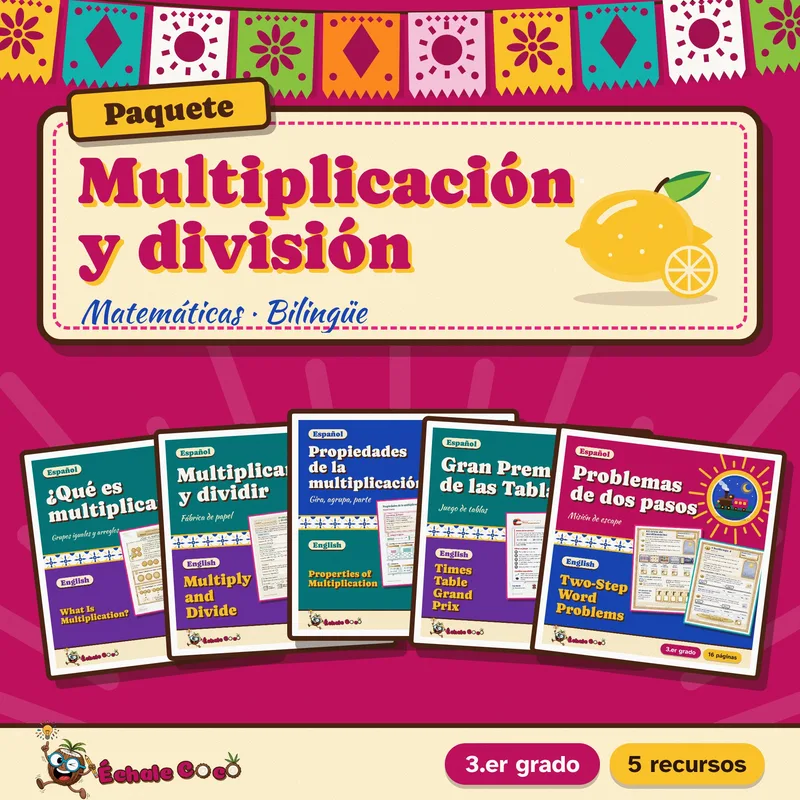
This 3rd grade bundle brings together five multiplication and division resources, all in Spanish with the English version. The What Is Multiplication? lesson includes two 16-slide presentations and a sheet with five exercises: in a lemon orchard, students move from repeated addition, 3 + 3 + 3 + 3 = 12, to multiplication. The 24 task cards are multiplication and division word problems within 100, with equal groups, arrays and measurements. The six properties worksheets take place on a shelf of marble jars arranged in rows and columns. The Times Table Grand Prix is a 30-space go-kart track with 36 plates for practicing multiplication and division facts. The midnight train escape mission wraps up with five challenges and ten two-step word problems. The order of the resources follows the order of the standards. Each resource includes its answer key.
Aligned to Common Core 3.OA.A.1, 3.OA.A.3, 3.OA.B.5, 3.OA.C.7 and 3.OA.D.8.
Separately: $22.00 · You save $4.40
You get all the files at once, ready to download and print.
This bundle includes 5 resources
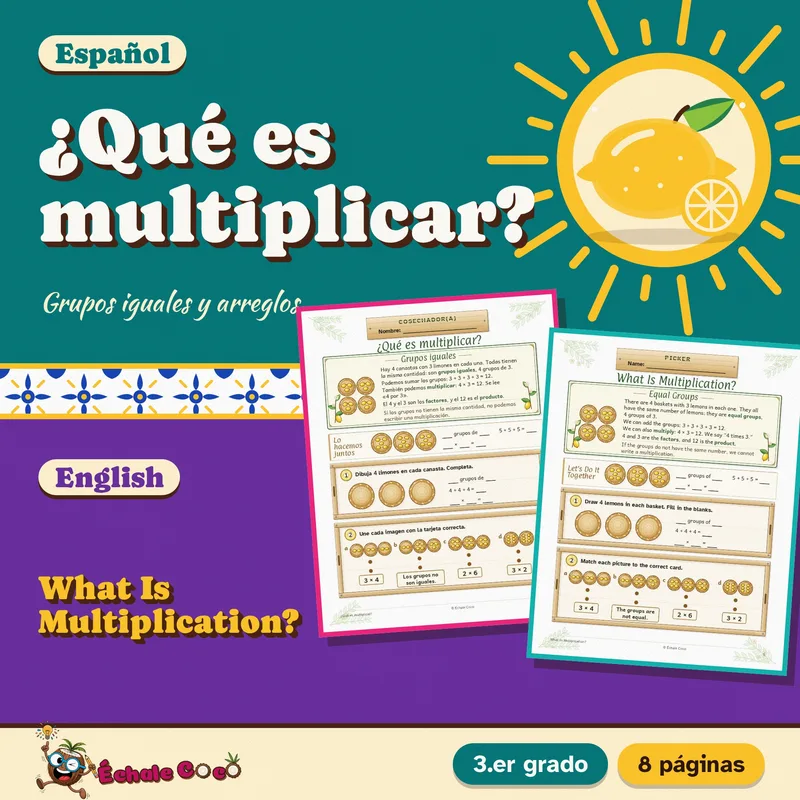
Spanish Multiplication Equal Groups & Arrays
Slides, Spanish + English
3$5.00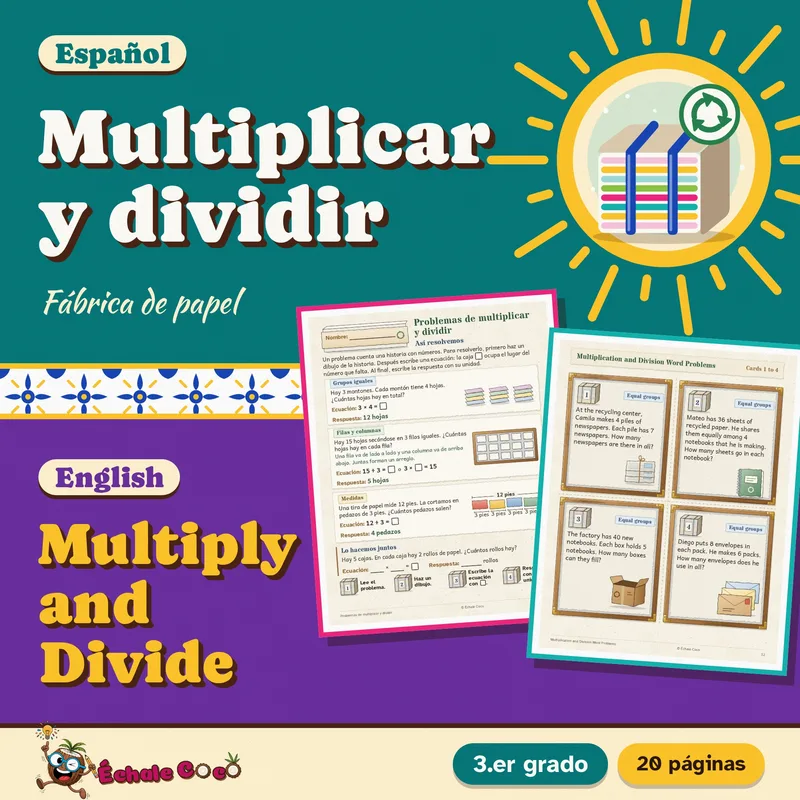
Spanish Multiplication Division Word Problems
Task Cards, Spanish + English
3$4.00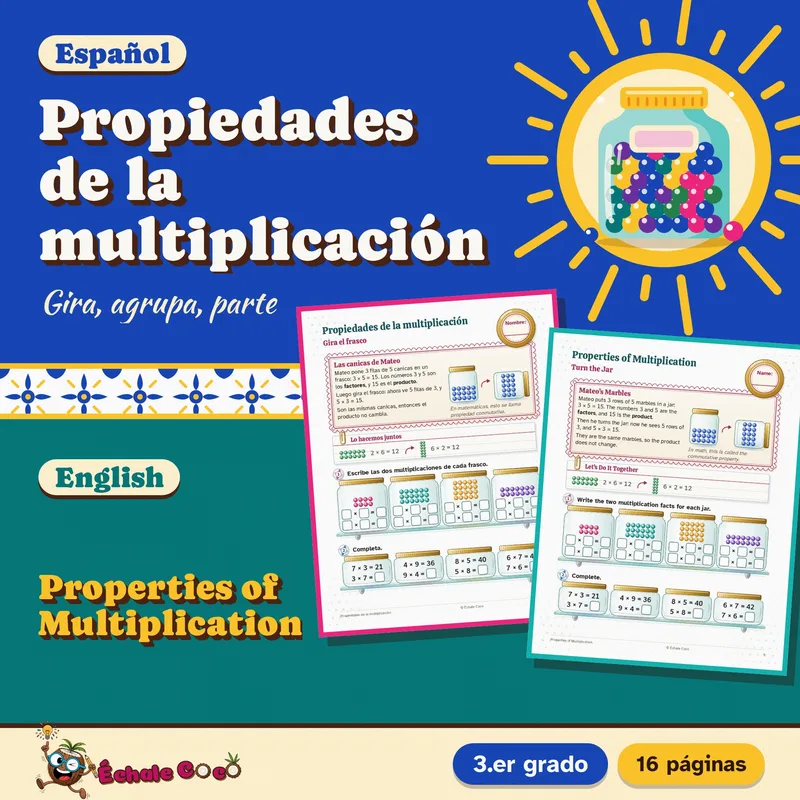
Spanish Multiplication Properties
Worksheets, Spanish + English
3$3.50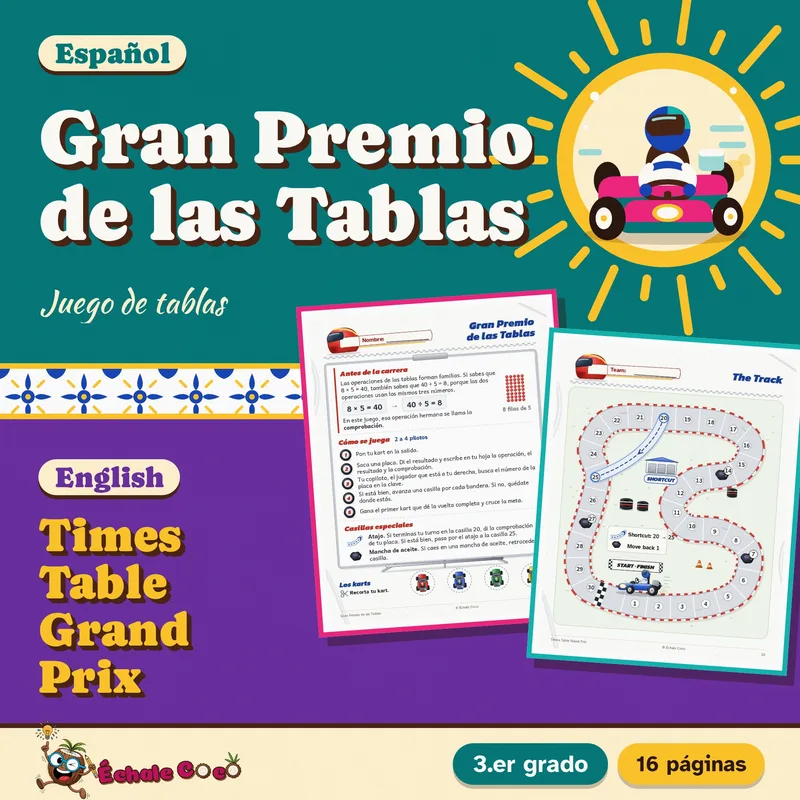
Multiplication Fact Game
Games, Spanish + English
3$5.00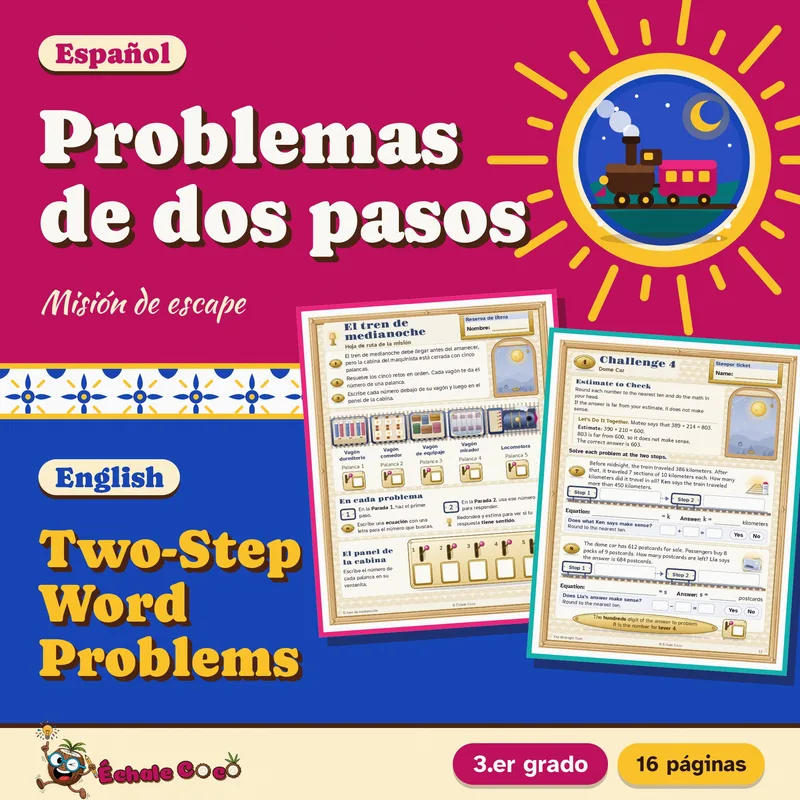
Spanish Two-Step Word Problems Escape Room
Escape Rooms, Spanish + English
3$4.50Standards
- 3.OA.A.1 Interpret products of whole numbers, e.g., interpret 5 × 7 as the total number of objects in 5 groups of 7 objects each. For example, describe a context in which a total number of objects can be expressed as 5 × 7.
- 3.OA.A.3 Use multiplication and division within 100 to solve word problems in situations involving equal groups, arrays, and measurement quantities, e.g., by using drawings and equations with a symbol for the unknown number to represent the problem.
- 3.OA.B.5 Apply properties of operations as strategies to multiply and divide.2 Examples: If 6 × 4 = 24 is known, then 4 × 6 = 24 is also known. (Commutative property of multiplication.) 3 × 5 × 2 can be found by 3 × 5 = 15, then 15 × 2 = 30, or by 5 × 2 = 10, then 3 × 10 = 30. (Associative property of multiplication.) Knowing that 8 × 5 = 40 and 8 × 2 = 16, one can find 8 × 7 as 8 × (5 + 2) = (8 × 5) + (8 × 2) = 40 + 16 = 56. (Distributive property.)
- 3.OA.C.7 Fluently multiply and divide within 100, using strategies such as the relationship between multiplication and division (e.g., knowing that 8 × 5 = 40, one knows 40 ÷ 5 = 8) or properties of operations. By the end of Grade 3, know from memory all products of two one-digit numbers.
- 3.OA.D.8 Solve two-step word problems using the four operations. Represent these problems using equations with a letter standing for the unknown quantity. Assess the reasonableness of answers using mental computation and estimation strategies including rounding.