
Home › Bundles › Addition and Subtraction Within 20 Bundle
Addition and Subtraction Within 20 Bundle
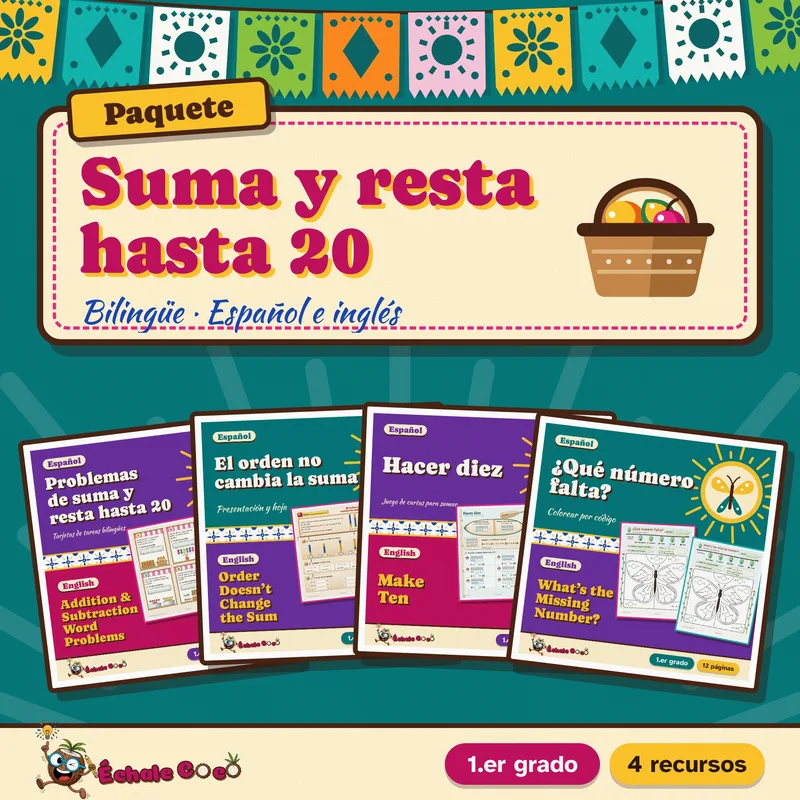
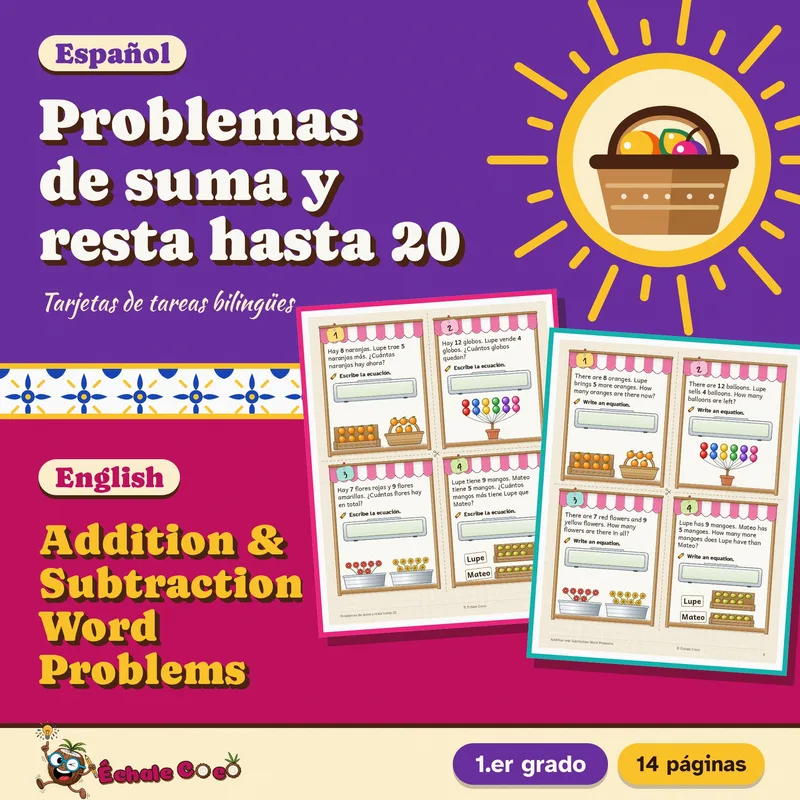
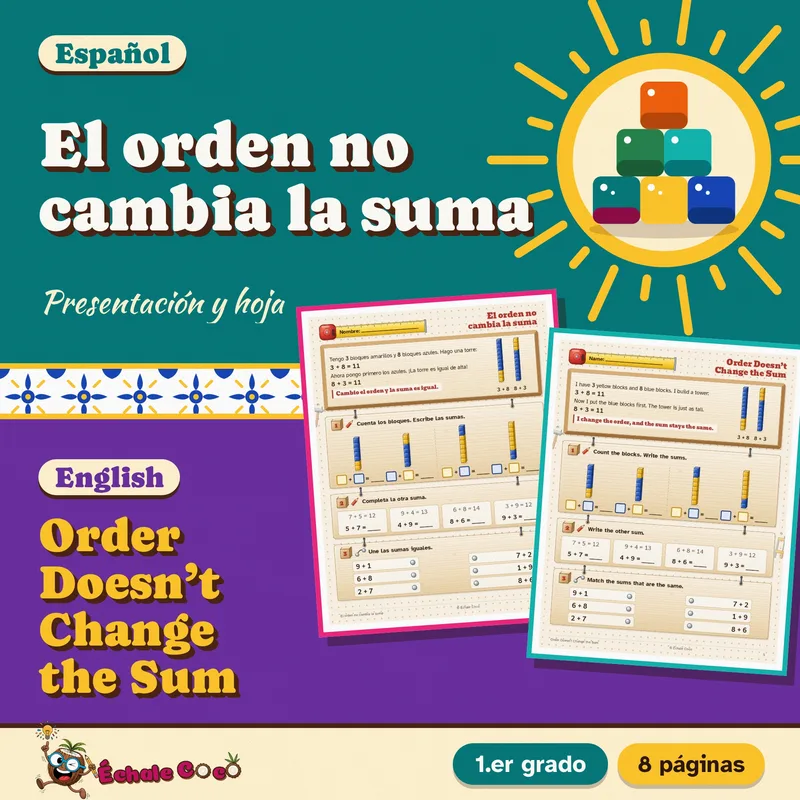
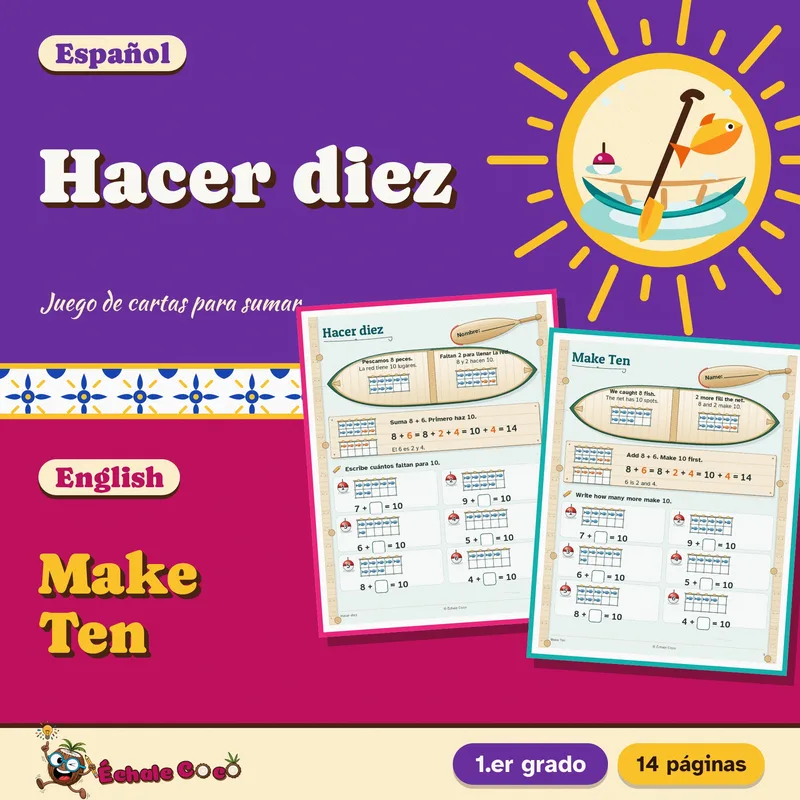
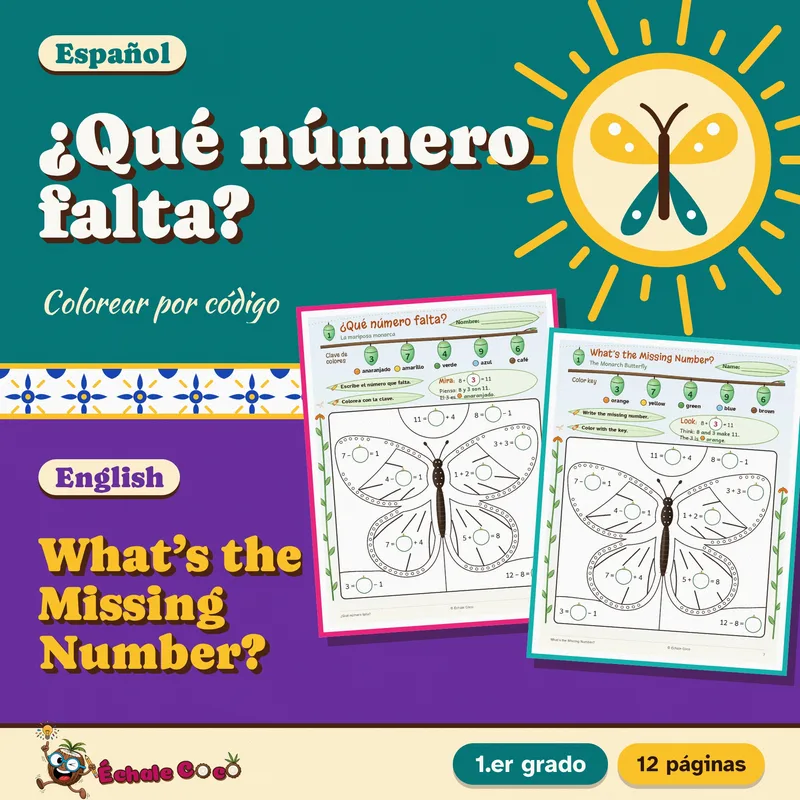
This 1st grade bundle brings together four math resources for adding and subtracting within 20, each in Spanish with the complete English version on separate pages. The lesson “Order Doesn’t Change the Sum” includes a 15-slide presentation and a two-page sheet set in a wooden toy workshop. The Make Ten card game practices the make-ten strategy with a mini lesson, illustrated rules and 36 fish cards. The 16 task cards are addition and subtraction word problems, ready for a math center. The four color-by-code pictures have 48 equations with a missing number, such as “8 = 12 − □.” Together they move from strategy to practice to word problems, and they work the same way in a dual language or bilingual classroom. Each resource includes its answer key.
Aligned to Common Core 1.OA.A.1, 1.OA.B.3, 1.OA.C.6 and 1.OA.D.8.
Separately: $17.00 · You save $3.40
You get all the files at once, ready to download and print.
This bundle includes 4 resources
Standards
- 1.OA.A.1 Use addition and subtraction within 20 to solve word problems involving situations of adding to, taking from, putting together, taking apart, and comparing, with unknowns in all positions, e.g., by using objects, drawings, and equations with a symbol for the unknown number to represent the problem.
- 1.OA.B.3 Apply properties of operations as strategies to add and subtract.3 Examples: If 8 + 3 = 11 is known, then 3 + 8 = 11 is also known. (Commutative property of addition.) To add 2 + 6 + 4, the second two numbers can be added to make a ten, so 2 + 6 + 4 = 2 + 10 = 12. (Associative property of addition.)
- 1.OA.C.6 Add and subtract within 20, demonstrating fluency for addition and subtraction within 10. Use strategies such as counting on; making ten (e.g., 8 + 6 = 8 + 2 + 4 = 10 + 4 = 14); decomposing a number leading to a ten (e.g., 13 – 4 = 13 – 3 – 1 = 10 – 1 = 9); using the relationship between addition and subtraction (e.g., knowing that 8 + 4 = 12, one knows 12 – 8 = 4); and creating equivalent but easier or known sums (e.g., adding 6 + 7 by creating the known equivalent 6 + 6 + 1 = 12 + 1 = 13).
- 1.OA.D.8 Determine the unknown whole number in an addition or subtraction equation relating three whole numbers. For example, determine the unknown number that makes the equation true in each of the equations 8 + ? = 11, 5 = � – 3, 6 + 6 = �.